
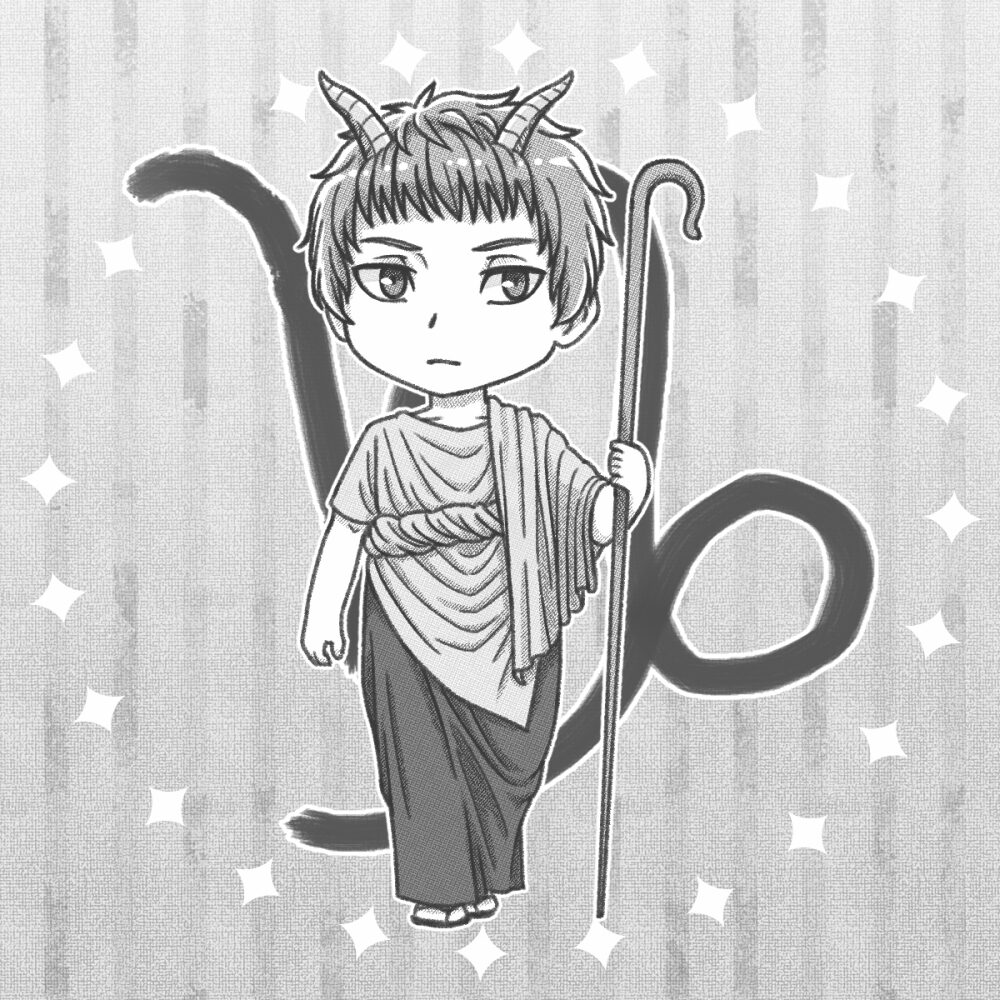
Tales of Twelve Stars
10th Tale: Capricorn
Status:
Skeleton Summary
──── ⋆⋅☆⋅⋆ ────
Part 1
The Set-up: Kastra became King of Miletus—a city in the Ionia region, after the death of his father. In a short period of time, he had established himself as a strict king who managed the city’s order and resources with a tight fist. He was an incredibly hardworking king, but nobody knows this as he rarely showed himself in public and his citizens found him unapproachable. They thought him too strict and unkind, so most people didn’t think too highly of him.
Call to Action: Kastra’s younger brother, who was far more likable and approachable to the citizens, also didn’t like the way Kastra ruled the city. So he thought of a way to overthrow his brother by using his supporters to start bad rumours about the king to start a revolt. Coincidently, yearly crop harvests were lower than usual. It wasn’t a big issue, but the people decided to use that as well as their dislike for the king as their reason to make him step down.
Call Refusal: Kastra didn’t particularly care if people liked him or not, but being blamed for the lower crop harvest made him feel both frustrated because there was nothing he could do about it, but at the same time like he had failed as a king. When the revolt happened, it was only then that Kastra realised how disliked he was by his people. He realised that even with all his hard work he did for them, if the people didn’t like him, he would not be accepted as king. So he relented, stepping down from his position and giving the crown to his younger brother to take his place.
No Return: After stepping down, Kastra could not show his face, and with some few belongings and supplies, he fled the city he once ruled and left behind everything that he had worked so hard on. His brother said it wasn’t necessary, but Kastra felt doing so was for the best. It was one of the hardest thing he has had to do since his crowning. He travelled for few days and nights and past a couple of other cities before he finally stopped and rested at the base of Corycus mountain. He had put as much distance between him and Miletus as his supplies would allow him, but now he was truly alone and left with nothing.
1st Struggle: Kastra was not a hunter, he did not have the skills to survive in the wild, so his only option was a paying job that would allow him to buy his survival. On Corycus, he found a goat herder and asked the man for a job. But the herder looked at his dirty clothes from many days of travel and took pity on him, deciding to take Kastra in and gave him shelter in one of his stables. Kastra was grateful to the herder and assisted the man in his goat herding.
Commitment: The goat herder became his mentor; aside from herding, he also showed Kastra how to make goat products and sell them at the nearby city of Erythrae. Once a year, the city would hold a festival called ‘The Kronia’ in honour of Cronus, the Father of Harvest, who would bless the land for yearly good harvest. Kastra found out that his mentor was also a priest, who was responsible for conducting the ritual of sacrificing a goat for Cronus to start off the festival. It was all so fascinating to him. Once a king and now a goat herder, Kastra found that he oddly didn’t mind it. It felt like a huge weight had left his shoulders, he no longer had to be responsible for an entire city and now here, nobody had any expectations of him. He was just a simple goat herder, and for the next few years that was how his life was.
──── ⋆⋅☆⋅⋆ ────
Part 2
2nd Struggle: Three years have past since he became a goat herder and Kastra was content with his current life. However, lately he had been hearing rumours of how Miletus had recently fallen into famine. While he had left his city, Kastra still held feelings for his old home and also wondered how his brother was fairing as king. The rumours of famine at his home city made him feel bad, so he made a decision. With money saved up since he started the job, Kastra went to his mentor who had cared for him all this time and asked to buy several goats off his herd. The man happily sold him the goats. The two parted ways on good feelings, then he left and brought all his goats with him back to the city of Miletus.
Crisis: After several days of travelling, Kastra arrived back at his home where he found the city in a worst state than when he had left it. He went to visit his brother and also found him is a similar depressive state. His brother upon seeing him, felt ashamed that he had not been able to maintain the city in the way Kastra had. After he left, the crop harvest continued to decrease yearly, to the point that they were now officially in famine. His brother thought that Kastra only came back to humiliate him for his failings as a king, but Kastra told him it was not the case. He loved the city and wanted to help it in any way he can. So he suggested a solution to his brother.
Climax: It was announced to the people of Miletus, that the king had decided to hold a festival and will be doing a public sacrifice to the Father of Harvest, Cronus to bring back the good harvest. At this announcement from their king, the people began to see some hope. So preparations were made and on the day of the festival, Kastra appeared for the public sacrifice. People were in disbelief that the dethroned king was the one doing the ritual. Having watched his old mentor do it a few times, Kastra knew what to do, he said a prayer to Cronus and ask that he accept the goat as an offering for a year of good harvest. Cronus sees the ritual and accepts the offer, the god blessed the land and miraculously crops and plants began to flourish. The people saw this and were amazed and cheered for Kastra. The rest of the day was spend celebrating the festival, where rich and poor, citizens and slaves alike were allowed to party as if everyone were equals. From then on, the Kronia became a yearly festival that continued the good harvest for the city.
Aftermath: Seeing how the people of Miletus has finally accepted Kastra, his younger brother asked if he wanted to take back the crown as king, since the brother no longer felt like he deserved the position. Kastra kindly refused and told him that the people loved him very much as king, since despite the famine the people still didn’t lose faith in him enough to dethrone him. As long as he continued to serve his people as a king should, then there was no need to change crowns again. Kastra, deciding that his job was done, took his leave from the city once again with his herd of goats. Zeus, who had been watching the events unfold, appeared before him. The god was very impressed with Kastra’s disciplined and practical nature, as well as touched by his self-sacrifice. Being able to impress Zeus’ father Cronus was also noteworthy, so the god decided to merge Kastra with the best goat in his herd—creating a man with goat horns—and named him the personification of Capricorn, giving him a place amongst the stars.